
Mobile Home Carports: Complete Guide to Sizes, Kits, Awnings & Ideas
Everything you need to know about carports for mobile homes — sizes, materials, kits, anchoring and installation — so you can protect your vehicles and get more use out of your lot.
In This Guide
- Carport Types for Mobile Homes
- Carport Sizes and What You Need
- Carport Products to Compare
- Steel vs Aluminum vs Wood
- Attached vs Freestanding
- Mobile Home Carport Awnings
- Mobile Home Carport Kits
- Mobile Home Carport Ideas
- How to Anchor Your Carport
- Installation Step by Step
- Carport vs Garage Cost Comparison
- Frequently Asked Questions
One of the most common upgrades I see on mobile home properties is a well-installed carport. A quality metal carport protects your vehicles, adds covered outdoor space, and costs a fraction of building a garage. Most carports ship directly to your door, and many handy homeowners can install one in a weekend.
Some links on this page are affiliate links. As an Amazon Associate I earn from qualifying purchases.

A large metal mobile home carport — these structures protect vehicles, add covered outdoor space, and ship directly to your door ready to assemble.
Mobile home carports have come a long way from the simple canvas awnings of the past. Today’s carports are engineered steel and aluminum structures rated for wind, snow, and UV exposure, and a good one can last many years with minimal maintenance. Whether you need a basic single-car cover or a full multi-bay structure with side panels and a concrete floor, there is a carport sized and priced for your property and budget.
Always Check Local Requirements First: Carport regulations vary significantly by state, county, and mobile home park. Some parks prohibit freestanding carports. Some counties require permits for carports over a certain size. Check with your local building department and mobile home park management before ordering — it takes 10 minutes and saves a lot of headaches.
Types of Carports for Mobile Homes
Not all carports are built the same. Understanding the main types helps you choose the right structure for your property, your climate, and your budget.
Metal Steel Carports
A very common choice for mobile homes. Galvanized steel carports are strong, durable, fire resistant, and need very little maintenance. Available in every size from single-car to triple-wide. Most ship directly to your door prefabricated and can be assembled in a day with basic tools. These are the structures you see in a lot of mobile home parks.
Aluminum Carports
Lighter weight than steel and rust-proof — a good fit for coastal areas, high humidity regions, or anywhere with heavy salt air exposure. Easier to move if you ever need to relocate the structure. Slightly less structural strength than steel but enough for many climates. A great choice if you are in a coastal state like Alabama or Florida.
Wood Frame Carports
A natural-looking option that complements mobile homes with traditional exterior styles. Wood carports can be customized to any dimension and painted or stained to match your home exactly. They require more maintenance than metal — annual staining or painting keeps them protected. Carport bracket kits make building a wood frame carport much easier and faster than traditional carpentry methods.
Attached Carports
Carports that connect directly to the side of your mobile home, sharing the home’s wall or roofline. These are especially popular because they allow you to go from your car to your door without stepping into rain or snow. Attached carports require careful installation to ensure the connection point doesn’t create a leak where it meets the home’s exterior.
Mobile Home Carport Sizes — What Do You Need?
Choosing the right size is the most important decision you’ll make. Too small and your vehicles hang out in the weather. Too large and you’re paying for structure you don’t use. Here’s a practical size guide:
| Carport Size | Vehicles It Fits | Best For | Typical Width |
|---|---|---|---|
| Single Car | 1 standard vehicle | Single-wide mobile homes, tight lots | 12 ft wide |
| Double Car | 2 standard vehicles | Most mobile home households | 18–22 ft wide |
| Triple Car | 3 vehicles or 2 + storage | Double-wides, larger lots, boat or RV storage | 26–30 ft wide |
| RV / Boat | 1 large RV or boat on trailer | Properties with recreational vehicles | 14–16 ft wide, 36–40 ft long |
| Custom Size | Any configuration | Unusual lot shapes or specific needs | Custom to order |
Sizing Tip: When measuring for your carport, add at least 2 feet of clearance on each side of your widest vehicle. For a standard pickup truck at 6.5 feet wide, you want at least a 12-foot-wide single-car bay minimum. If you have a crew cab truck, full-size SUV, or van — go 14 feet wide per bay. You will never regret going slightly larger. You will regret going too small every single time you open your door.
Shop by Size
Know exactly what size you need? These common dimensions ship directly to your property with no store pickup required.
10 x 20 Carport
The most compact single-car option — 10 feet wide by 20 feet long. Fits one standard vehicle on a tight lot. Good for single-wide mobile homes with limited side yard space.
12 x 20 Carport
A comfortable single-car size — 12 feet wide gives good door clearance for trucks and SUVs.
20 x 20 Carport
The standard double-car size — fits two full-size vehicles side by side with comfortable clearance. Also works as one vehicle plus a workshop or outdoor living area on the second bay.

A large double-car carport next to a doublewide mobile home — a double-car carport is a common choice for mobile home households.
Carport Products to Compare
Aluminum, steel, 2-car carports, awnings, kits and tools — shipped to your property.
Metal Carports
Full metal carport structures rated for wind and snow loads, in a range of sizes.
Aluminum Carports
Rust-proof aluminum carports that don’t need painting. Lightweight and well suited to coastal and humid regions.
Steel Carports
Heavy-duty galvanized steel carports built for high wind and heavy snow loads — a strong option for snowy states like Michigan, Indiana, and Ohio.
2 Car Carports
Wide enough for two full-size vehicles with room to open doors comfortably. Available in several finishes.
Carport Awnings
Retractable and fixed awnings for covered outdoor space without a full metal structure. Multiple sizes and colors available.
Wood Frame Carport Bracket Kits
Steel hardware kits for building wood frame carports — connectors and brackets included. You supply the lumber.
Tool Kits for Installation
Home tool kits — hammers, tape measures, levels, and the basics you need to install your carport correctly.
Aluminum vs Steel Carports for Mobile Homes
Aluminum and galvanized steel are the two most common carport materials. Each one makes sense in different situations:
When Aluminum Makes Sense
Aluminum doesn’t rust. In states like Alabama, Texas, and along any coastal area, a steel carport can eventually show surface rust even with galvanized coating. Aluminum weighs less than steel, which makes installation easier, holds up well against salt air and humidity, and needs little maintenance beyond an occasional rinse. The upfront cost is slightly higher than steel, but the lifetime cost can be lower.
When Steel Carports Make More Sense
If you are in a heavy snow state — Michigan, Indiana, Ohio, or anywhere that regularly sees 12+ inches of snow — galvanized steel is the stronger structural choice. Steel carports have higher load ratings per square foot and handle heavy snow accumulation better than aluminum. For inland properties far from salt air, galvanized steel is an excellent value and slightly more affordable than aluminum.
Steel vs Aluminum vs Wood — Full Material Comparison
Each material has real strengths and real weaknesses. Here is a general breakdown:
| Material | Lifespan | Maintenance | Best Climate | Cost |
|---|---|---|---|---|
| Galvanized Steel | 20–30 years | Very low — occasional wash down | All climates, especially heavy snow regions | Mid-range |
| Aluminum | 25 years or more | Minimal — doesn’t rust | Coastal, humid, high salt-air areas | Mid to high |
| Wood | 15–25 years | High — annual stain/paint required | All climates with proper maintenance | Low to mid |
| Polycarbonate Roof | 10–15 years | Low — UV yellowing over time | Moderate climates, not heavy snow | Low |
My Take: For most mobile home owners in Michigan, Indiana, and Ohio, galvanized steel is the practical pick. It handles heavy snow loads, resists rust, needs very little maintenance, and ships prefabricated. If you are in Alabama, Texas, or anywhere with saltwater air, aluminum is the smarter long-term choice even at a slightly higher upfront cost.
Attached vs Freestanding Carports for Mobile Homes
This is one of the most common questions I get — and the right answer depends on your specific situation.
Attached Carport
Connects directly to the side of your mobile home. Walk from your car to your door without stepping into the rain or snow. Requires careful installation at the attachment point to prevent water intrusion. Check your home’s exterior wall condition before attaching — the wall needs to be solid and weather-tight. Before you attach anything, check your home’s installation manual or ask the manufacturer — many mobile home walls aren’t built to carry extra roof load (especially snow), so a freestanding carport set just off the home is often the safer choice.
Freestanding Carport
Stands completely independently from your mobile home with its own posts and foundation points. More flexible placement — can go anywhere on your lot. No risk of water intrusion where it meets your home. Easier to relocate or remove if needed. Required in some mobile home parks that prohibit structures attached to the home. Generally considered the safer DIY option.

An attached carport with a concrete floor — attached carports let you get from your vehicle to your front door without walking through the weather, which is especially handy in snowy winters.
Mobile Home Carport Awnings
Carport awnings are the lightweight, lower-cost alternative to a full metal carport structure. They are ideal when you want covered outdoor space without the permanence or cost of a full carport — or when your mobile home park restricts freestanding structures.
Retractable Awnings
Extend for shade and protection, retract when you want full sun or during severe weather. Best for outdoor living space rather than vehicle protection. Great for mobile home decks and patios.
Fixed Awnings
Permanently attached to the home’s exterior wall. More stable than retractable options and provide year-round protection. Common on mobile homes as a budget-friendly covered parking solution.
Canopy Style
Portable canopy structures that can be set up quickly and moved as needed. Not as durable as a proper metal carport but a budget-friendly starting point or temporary solution.
Awning Tip: Carport awnings work well for shade and light rain but are not designed for heavy snow loads. If you are in a snow-prone area like Michigan or Indiana, invest in a properly rated metal carport rather than relying on an awning for vehicle protection through winter.
Mobile Home Carport Kits — Build It Yourself
Carport kits are prefabricated packages that include all the structural components you need to build a carport from scratch. Metal carport kits come with pre-cut steel or aluminum framing. Wood frame carport kits include the steel bracket hardware that connects lumber into a solid structural frame.
Metal Carport Kits
Pre-cut steel or aluminum framing that bolts together without welding. Most kits include all hardware and detailed instructions. A standard double-car metal kit can be assembled in one full day by two people with basic tools. All sizes ship directly to your property — no store pickup or hauling required.
Wood Frame Carport Bracket Kits
Steel connection brackets that allow you to build a carport frame from standard lumber. You purchase the lumber locally and the kit provides the metal hardware — post bases, rafter brackets, ridge connectors — to assemble a solid wood-framed carport without complex carpentry. A great option if you want a custom size or a look that matches your home’s existing wood structures.
Mobile Home Carport Ideas
A carport does not have to be just a metal roof over a parking space. Here are some popular mobile home carport ideas that add function to your property:
Covered Outdoor Living Space
Turn part of your carport into an outdoor living area. Park the car on one end, set up furniture on the other. A 20-foot-wide carport gives you room for a vehicle plus a seating area, so the same structure doubles as covered outdoor space.
Storage and Workshop
Enclose one or two sides of your carport with panels to create a semi-enclosed storage or workshop area. Great for seasonal equipment, garden tools, bikes, and outdoor power equipment. Side panels can be added to most metal carport kits.
Boat and RV Storage
A tall single-bay or wide double-bay carport makes an excellent cover for a boat on a trailer or a small RV. Protects your investment from UV, rain, and snow without the cost of a storage unit. Make sure the carport height matches your RV or boat-on-trailer height.
Enclosed Porch or Sunroom Conversion
Some mobile home owners add side panels, screens, or even windows to their attached carports to create a screened porch or informal sunroom. It can be a lower-cost way to get more usable covered space — check with your local building department and park before enclosing a carport.
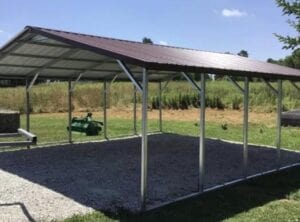
A metal carport with a gravel floor and partial side enclosure — a popular idea that adds storage protection while keeping costs low.

A carport with a built-in deck and outdoor seating area — using part of the carport footprint as outdoor living space is a good way to get more out of the structure.
How to Anchor Your Mobile Home Carport
This is the most overlooked step in carport installation — and the most dangerous one to skip. An unanchored carport is a wind sail waiting to happen. In a storm it can tear away, damage your mobile home, damage neighboring property, and injure people. Proper anchoring is not optional.
Insurance Check: Ask your insurance agent how your policy handles damage caused by a carport — including damage it could do to your home or a neighbor’s — and anchor properly before your first storm season.
Concrete Anchor Footings
The most permanent and strongest anchoring method. Dig a footing hole at each post location, set the post in a concrete tube form, pour concrete, and allow to cure. This method is best if you want a permanent carport that will not be moved. Required in many jurisdictions for any carport over a certain size.
Ground Auger Anchors
Screw-in auger anchors driven into the ground at each post — connected to the post with steel straps. This is the same type of anchor system used for mobile home tie-downs. Easier to install than concrete footings and allows the carport to be moved if needed. Best for areas with firm soil.
Related Guide: For more on anchor types, installation depths, HUD wind zone requirements, and hardware — read the complete mobile home anchors guide. The same anchoring principles that apply to securing your mobile home apply to securing your carport.
Carport Anchoring Checklist
- Every post has its own anchor point — never skip a post
- Anchors are driven to full depth for your soil type
- Steel connections use galvanized hardware — not bare steel that will rust
- Carport is level before anchoring — anchor a crooked carport and it stays crooked
- All connection points are tight and fully fastened
- Carport is secured to your mobile home if attached — not just resting against it
- Local permit obtained if required in your area
- Annual inspection planned — check after every severe storm
How to Install a Mobile Home Carport Step by Step
Most metal carport kits can be installed by two people in one day. Here is the process from site prep to final tightening:
Choose Your Location and Check Utilities
Mark your carport footprint with stakes and string. Call 811 (the national call-before-you-dig number) to have underground utilities marked before you dig any anchor holes or drive any ground anchors. Gas lines, electric lines, water and sewer lines can all be within a foot of the surface near a mobile home.
Prepare the Ground Surface
The ground under your carport should be level, firm, and well-drained. Gravel is a common base — it drains well, stays firm, and is easy to install. A concrete pad is the premium option and the easiest to keep clean. Bare dirt works but can get muddy and soft under vehicle weight over time.
Install Anchor Points Before Raising the Frame
Set concrete footings or drive auger anchors at every post location before you assemble any framing. It is much easier to anchor before the structure is up than after. Let concrete footings cure before loading them with the carport frame — follow the concrete manufacturer’s directions (at least 24–48 hours, and longer in cold weather).
Assemble the Frame on the Ground First
For metal carport kits, lay out and loosely assemble as much of the frame as possible on the ground before raising it. This is much safer and easier than trying to connect pieces overhead. Have all your hardware sorted and your tools within reach before you start raising anything.
Raise and Set Posts First
Two people are needed for this step — one holds the post plumb and level while the other makes the initial connections and anchor attachments. Use a level on every post in two directions before tightening anything permanently. A post that is even slightly out of plumb will cause problems throughout the entire structure.
Install Roof Framing and Panels
Work from one end to the other attaching roof purlins and panels. On metal carport kits, roof panels screw directly to the framing with self-tapping screws. Do not overtighten — metal panels can warp and leak at the screws if overtightened. Follow the kit instructions for screw spacing exactly.
Final Tightening and Inspection
Go back to every connection and anchor point and tighten everything fully. Check that all anchor points are secure. Check that the roof is properly pitched for drainage — water should run off the low end, not pool in the middle. Do a final level check and adjust as needed before considering the job complete.

Multiple carports installed across a mobile home park — when properly anchored and installed, metal carports provide many years of vehicle protection with minimal maintenance.
Carport vs Garage — Cost Comparison
One of the most common questions I get is whether to build a garage or install a carport. Here is an honest comparison:
| Factor | Metal Carport | Traditional Garage |
|---|---|---|
| Upfront Cost | $1,500 – $5,000 | $15,000 – $50,000+ |
| Installation Time | 1–2 days DIY | Weeks with contractors |
| Permits Required | Sometimes — check locally | Usually required |
| Property Tax Impact | Varies — check with your local assessor | Usually increases assessed value |
| Maintenance | Very low | Moderate — roof, doors, etc. |
| Relocatable | Yes | No |
| Security | Open sides — vehicles visible | Full enclosure with locking door |
The Bottom Line: For most mobile home owners, a carport is the practical choice. The cost difference is large and installation is fast. If enclosed, secure storage is your priority, read the mobile home garage guide — or consider a carport plus a separate storage shed, which often costs less than a garage and gives you more flexibility.
Would You Rather Sell Than Repair?
If a carport is just one item on a long list of things the home needs, selling it as-is is one option to compare. I buy mobile homes that need work, and you don’t have to fix anything first.